
The AI Datacenter Revolution: From General-Purpose Compute to the Age of AI Factories
How a $933 billion market is reshaping the very fabric of enterprise infrastructure — and what it means for everyone from hyperscalers to investors
Introduction: The Ground Beneath Our Feet Has Shifted
I’ve spent the better part of two decades designing, building, and operating datacenters. For most of that career, the conversation was about efficiency — better PUE, lower latency, more VMs per rack. The workloads were predictable. The architectures were standardized. The industry moved at a comfortable, iterative pace.
Then came 2023.
What I’ve witnessed over the past 36 months isn’t an evolution — it’s a full-scale transformation. The datacenter, once a utility-like backdrop to enterprise IT, has become the central nervous system of the global economy. And at its heart? Artificial intelligence.
Consider this: the global AI datacenter market is projected to grow from $236 billion in 2025 to $933 billion by 2030 — a compound annual growth rate of 31.6%. To put that in perspective, that’s nearly four times the size of the entire global cloud infrastructure market just a few years ago.
But these numbers, as staggering as they are, tell only part of the story. The real story is about architecture, physics, economics, and power — and how every single player in the technology ecosystem is being forced to adapt or be left behind.
A Brief History: How We Got Here
To understand where we’re going, we need to understand where we’ve been.
The Mainframe Era (1960s-1980s): Datacenters were monolithic, proprietary, and the domain of governments and the largest corporations. Compute was scarce and expensive.
The Client-Server Era (1990s-2000s): The rise of x86 servers, standardized networking, and distributed architectures democratized compute. Datacenters became more numerous but remained largely on-premises.
The Cloud Era (2010-2020): Hyperscalers — AWS, Azure, Google Cloud — aggregated compute at unprecedented scale. Datacenters became multi-tenant, software-defined, and globally distributed. The focus was on virtualization, elasticity, and operational efficiency.
The AI Era (2023-Present): This is where everything changes. Traditional datacenters were built around CPUs and general-purpose workloads. AI datacenters are built around GPUs, TPUs, and specialized accelerators — and they operate under an entirely different set of physical and economic constraints.
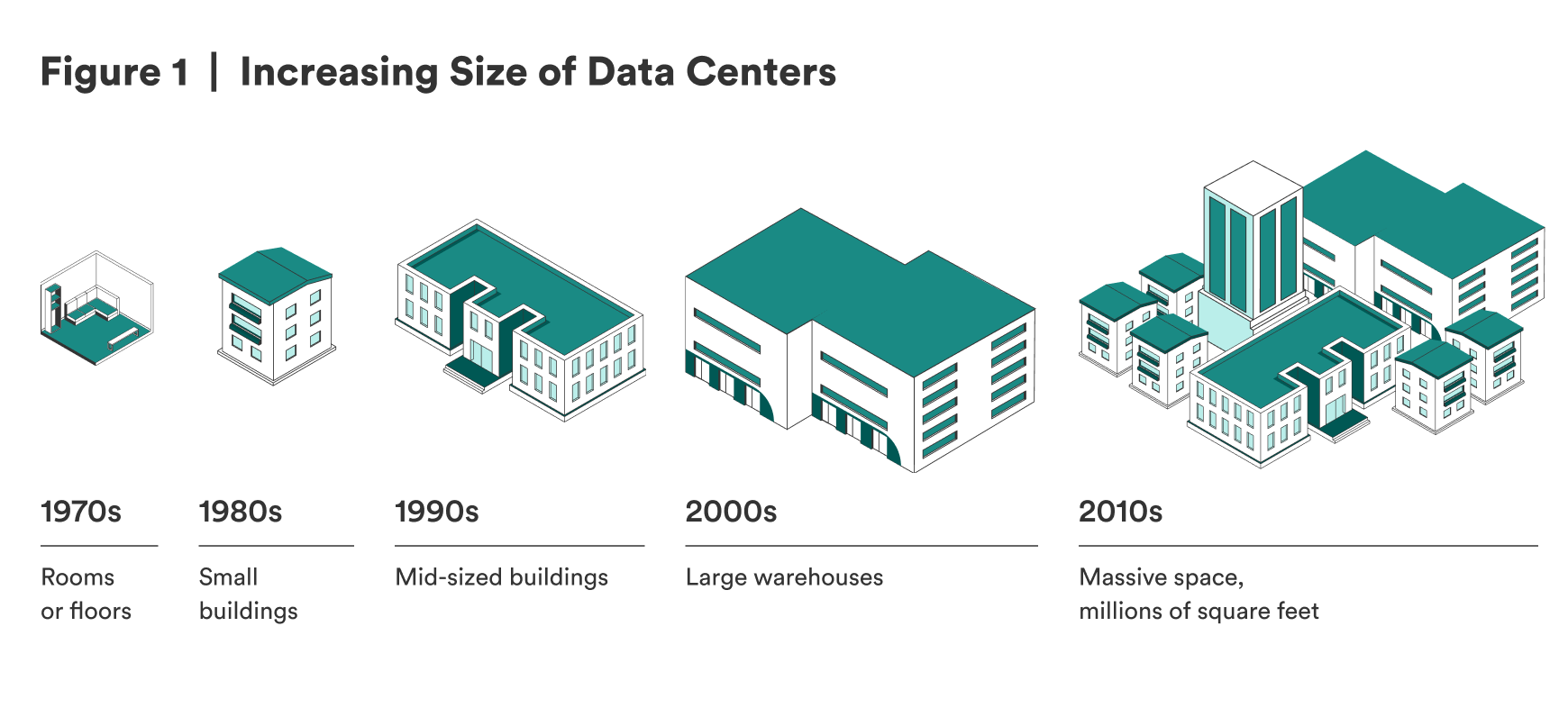 Source: NewAmerica.org
The key insight? Traditional datacenters were about serving applications. AI datacenters are about training intelligence. That distinction changes everything — from the hardware you buy, to the power you consume, to the people you hire.
What Makes an AI Datacenter Different?
Let me be direct: if you’re designing an AI datacenter the way you designed a traditional cloud datacenter, you’re going to fail. The physics simply don’t work.
Here’s what’s different:
1. Power Density
A traditional enterprise rack might consume 5-10 kW. A high-density cloud rack might hit 15-20 kW. An AI training rack? 40-130 kW — and climbing.
The NVIDIA GB200 NVL72, for example, can push a single rack beyond 120 kW. That’s not a gradual increase — it’s a step function that breaks every assumption about power distribution, cooling, and facility design.
2. Cooling
Air cooling, which has served the industry for decades, is simply inadequate above 20 kW per rack. For AI workloads, liquid cooling is no longer optional — it’s mandatory.
Direct-to-chip (D2C) liquid cooling is now the standard for high-density AI deployments, with immersion cooling gaining traction for the most extreme densities. The efficiency gains are dramatic: liquid cooling can be 3,000 times more efficient than air for removing heat from AI hardware.
3. Networking
In a traditional datacenter, network latency is measured in milliseconds. In an AI training cluster, microseconds matter. The interconnect — whether InfiniBand or high-speed Ethernet — is as critical as the GPUs themselves.
A single training run on a large language model might involve thousands of GPUs communicating constantly. If the network can’t keep up, your $30,000 GPUs sit idle — and your training time doubles.
4. Economics
Here’s a number that should grab your attention: a single fully loaded AI rack can represent $500,000 to $1 million in IT equipment alone. And that’s before you account for the facility, the cooling, the power infrastructure, and the ongoing operational costs.
The capital intensity of AI infrastructure is unprecedented. And it’s changing the fundamental economics of the datacenter industry.
The New KPI: Tokens per Megawatt
In traditional datacenters, the key metric was PUE — Power Usage Effectiveness. How much of the power you draw goes to compute versus overhead?
In AI datacenters, we need a more sophisticated metric. The question isn’t just how efficiently you use power — it’s how much intelligence you produce per unit of energy.
Enter Tokens per Megawatt — the measure of AI output per unit of energy consumed. This metric captures the true efficiency of an AI datacenter: not just how well it manages power, but how effectively it converts electricity into useful AI capability.
For context:
A typical AI training workload might consume 25-30 MW at base load, spiking to 45 MW during checkpointing
AI inference workloads are generally more variable, with base loads of 5-10 MW but spiking dramatically during traffic surges
The Four Pillars of AI Infrastructure
As we look across the AI datacenter landscape, I see four distinct categories of players — each with their own value proposition, each serving different customer needs, and each facing unique challenges.
1. Incumbent Hyperscalers (AWS, Azure, GCP, OCI)
These are the giants. They own the global footprint, the integrated stacks, and the deep pockets.
-
-
-
AWS: ~29% global cloud market share
-
Microsoft Azure: ~20%
-
Google Cloud: ~13%
-
Oracle Cloud: ~5% but growing at 68% year-over-year
-
-
Value Proposition: Full-stack integration, global reach, enterprise-grade security and compliance, massive ecosystems.
The Oracle Angle: Oracle is arguably the most aggressive hyperscaler in AI infrastructure right now. Their OCI revenue grew 68% in Q2 FY2026, and they’re projecting cloud infrastructure revenue of $144 billion by fiscal 2030. Their partnership with NVIDIA and AMD, combined with their role in the “Stargate” project, positions them as a serious contender.
2. Neoclouds / GPUaaS Providers (CoreWeave, Lambda Labs, Nebius, Crusoe)
These are the disruptors — specialized providers built from the ground up for AI workloads.
-
-
-
CoreWeave: Went public in March 2025 at a $23B valuation; stock up 265% to ~$60B market cap. Operating 250,000+ GPUs with ~$3.5B run-rate revenue
-
Nebius: Born from Yandex’s $5.4B sale; targeting $1.1B ARR by end-2025 (9x growth). NVIDIA invested $700M
-
Crusoe: Controls the entire value chain from power generation to modular datacenter construction. $535M revenue in 2025 (+113% YoY); lead contractor on Stargate
-
Lambda Labs: Focus on developer experience; $600M+ revenue run-rate with 40% of volumes from GPU resales for AWS and Microsoft
-
-
Value Proposition: Faster access to the latest GPUs, more competitive pricing, specialized expertise, simpler billing models.
3. Colocation Providers (Equinix, Digital Realty, NTT)
These are the “landlords” — providing the physical shell, power, and cooling while clients bring their own IT equipment.
Europe colocation market: Valued at $9.45B in 2024, projected to reach $35.73B by 2030 at 24.82% CAGR
Value Proposition: Geographic flexibility, physical control, data sovereignty, capital-light expansion for hyperscalers and neoclouds.
4. AI Silicon Providers (NVIDIA, AMD, Intel, Cerebras, Groq, AWS)
The engine room. These companies are pushing the boundaries of what’s physically possible.
-
-
-
NVIDIA: Still the undisputed leader, but facing increasing competition
-
AMD: MI300X/MI325X/MI355X series gaining ground, particularly for inference
-
Cerebras: Wafer-scale computing with 4 trillion transistors, 900,000 AI cores
-
Groq: Tensor Streaming Processor achieving 500+ tokens per second — 10x faster than comparable GPUs
-
-
Summary Table: The AI Infrastructure Landscape
| Player Type | Key Examples | Market Share / Scale | Core Differentiator | Primary Risk |
|---|---|---|---|---|
| Hyperscalers | AWS (29%), Azure (20%), GCP (13%), OCI (5%) | ~62% of global cloud market | Full-stack integration, global footprint | Vendor lock-in, complexity |
| Neoclouds | CoreWeave, Nebius, Crusoe, Lambda | CoreWeave: $60B+ market cap; 250K+ GPUs | Specialized AI focus, price-performance | Customer concentration, limited services |
| Colocation Providers | Equinix, Digital Realty, NTT | Europe: $35.73B by 2030 | Physical control, data sovereignty | No compute services, high client CapEx |
| AI Silicon Providers | NVIDIA, AMD, Cerebras, Groq | NVIDIA dominates; AMD gaining | Performance, efficiency, ecosystem | Rapid obsolescence, supply constraints |
How This Matters for Four Key Audiences
-
- For AI Infrastructure Providers: The opportunity is massive, but the window is closing. Those who can secure power, deploy liquid cooling, and build at scale will win. Those who can’t will be left behind.
- For AI Silicon Providers: The battle is no longer just about raw performance — it’s about total cost of ownership, ecosystem integration, and power efficiency. The winners will be those who optimize for the datacenter as a whole, not just the chip.
- For Industry IT Leaders: The days of “one size fits all” infrastructure are over. Your AI workloads have fundamentally different requirements than your traditional workloads. Plan accordingly.
- For Investors: The AI infrastructure market is projected to exceed $500 billion annually by 2030. But not all players are created equal. The key is identifying those with sustainable competitive advantages — not just those riding the wave of temporary GPU scarcity.
Looking Ahead: What’s Coming in Post 2
In the next installment, we’ll dive deep into the technical architecture of AI datacenters — the racks, the GPUs, the memory, the networking, and the cooling systems that make it all possible. We’ll compare NVIDIA’s latest offerings against the growing field of alternatives, and we’ll explore the emerging memory technologies (HBM4, SOCAMM2) that are redefining what’s possible.
We’ll also examine the five primary industries driving AI datacenter demand — and the specific use cases, budgets, and timelines that matter for each.
Key Takeaways:
-
-
-
The AI datacenter market is growing at 31.6% CAGR and will reach $933 billion by 2030
-
Power density is the defining constraint — AI racks consume 40-130 kW vs. 5-10 kW for traditional racks
-
Liquid cooling is no longer optional — air cooling fails above 20 kW/rack
-
The competitive landscape is fragmenting — hyperscalers, neoclouds, colocation providers, and silicon vendors are all vying for position
-
Tokens per Megawatt is the new KPI — efficiency is measured in intelligence per unit of energy
-
-
References
-
-
MarketsandMarkets, “AI Data Center Market Report 2025-2030”
-
Research and Markets, “AI Datacenters Market Report 2026”
-
Axevil Capital, “Neo-Cloud AI Providers: CoreWeave, Nebius, Lambda Labs, Crusoe Compared”
-
Investors.com, “Oracle’s AI Gains ‘Are Clear'”
-
Oracle Investor Relations, “Fiscal Year 2026 Second Quarter Financial Results”
-
Business Wire, “Western Europe Colocation Data Center Portfolio Analysis Report 2025”
-
[End of Post 1]
In Post 2, coming next: The Technical Architecture of AI Datacenters — Racks, GPUs, Memory, Networking, and Cooling. We’ll compare NVIDIA H200 vs. B200, explore the growing field of non-GPU accelerators, and examine the memory technologies (HBM4, SOCAMM2) that are enabling the next generation of AI compute.