
Introduction: The Great Infrastructure Transformation
The data center industry is experiencing its most significant transformation since the advent of cloud computing. What began as facilities housing general-purpose CPUs for web hosting and enterprise applications has evolved into specialized AI factories designed to handle extreme power densities, unprecedented heat loads, and massive parallel processing requirements.
As an expert who has led 15+ “Design-Build-Operate” projects for AI datacenters across Life Sciences, Automotive, Energy, and Banking sectors, I’ve witnessed firsthand how the infrastructure landscape is being rewritten. The numbers tell a compelling story: the AI datacenter market is growing at a 28.3% CAGR, with global capacity projected to more than triple by 2030, and approximately 40% of this demand driven by Generative AI.
This is the first article in a comprehensive three-part series examining the AI infrastructure ecosystem. Here, we’ll explore the evolution from traditional data centers to AI-optimized facilities, examine the principal use cases driving demand, and establish the quantitative benchmarks that define this new era. Subsequent articles will dive deep into the competitive landscape of infrastructure providers and the technical architectures powering these facilities.
From Bits to Intelligence: A Brief History
The Evolution Timeline:
1990s-2000s: The Enterprise Era
-
-
Traditional data centers: 3-5 kW per rack
-
Primary workloads: Databases, email, file storage
-
Cooling: Standard air conditioning
-
PUE (Power Usage Effectiveness): 1.8-2.0
-
2010s: The Cloud Revolution
-
-
Hyperscale data centers emerge (AWS, Azure, Google Cloud)
-
Rack density increases to 10-15 kW
-
Virtualization becomes standard
-
PUE improves to 1.4-1.6
-
2020s-Present: The AI Factory
-
-
AI-optimized facilities: 40-100+ kW per rack
-
Liquid cooling becomes mandatory for high-density zones
-
PUE targets: ≤1.2 (with immersion cooling achieving 1.05-1.15)
-
New metric emerges: Tokens per Megawatt as the ultimate efficiency KPI
-
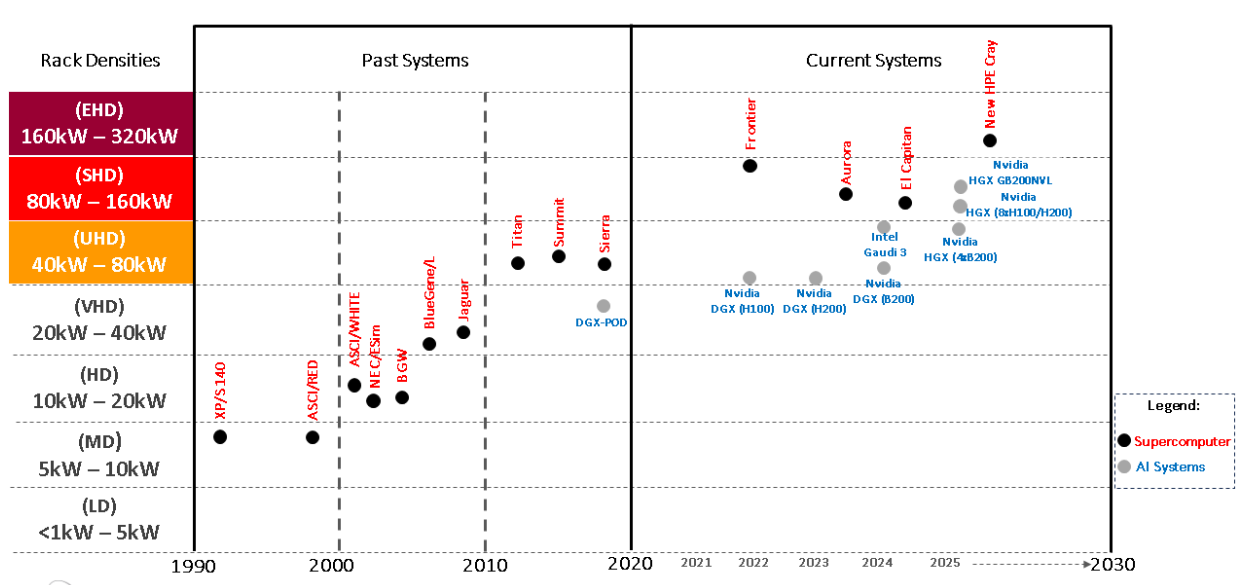
“Evolution of Data Center Rack Density (2000-2030)” source:
Principal AI/HPC Use Cases Driving Infrastructure Demand
The demand for AI infrastructure isn’t uniform—it varies dramatically by industry, workload type, and computational requirements. Based on my evaluations across multiple sectors, here are the primary use cases reshaping infrastructure requirements:
1. Large Language Model (LLM) Training & Foundation Models
Workload Characteristics:
-
-
-
Compute Intensity: Extreme—requires massive GPU clusters running for weeks or months
-
Power Requirements: 25-30 MW base load per facility, spiking to 45 MW during checkpointing
-
Hardware: NVIDIA H100/H200/B200, AMD MI300X/MI450 clusters
-
Networking: InfiniBand NDR/HDR or high-speed Ethernet (800GbE)
-
Memory: HBM3/HBM4 with 80GB-192GB per GPU
-
-
Industry Applications:
-
-
-
Technology/Hyperscalers: Developing foundational models (GPT-4o, Gemini, Llama 3)
-
Healthcare: Training models for drug discovery and genomic analysis
-
Automotive: Autonomous driving perception models requiring 1,000+ GPU clusters
-
-
Quantitative Benchmarks:
-
-
-
Training a frontier LLM (e.g., GPT-4 scale): 10,000+ H100 GPUs for 90-120 days
-
Power consumption: ~50 GWh per training run
-
Cost: $2M-$10M+ per training cycle (excluding infrastructure CapEx)
-
-
Datacenter Practitioner’s View:
The training market is experiencing a gold rush mentality, with hyperscalers and neoclouds racing to stockpile GPUs. However, I believe we’ll see a correction by 2027-2028 as the focus shifts from pure training capacity to inference efficiency. Organizations over-investing in training-only infrastructure without inference capabilities will face stranded assets.
2. AI Inferencing at Scale
Workload Characteristics:
-
-
-
Compute Intensity: Moderate to High—depends on model size and request volume
-
Power Requirements: 5-10 MW base load, spiking to 12 MW during traffic surges
-
Latency Requirements: <50ms p99 for real-time applications; <10ms for trading/fraud detection
-
Hardware Mix: NVIDIA L40S, L4, repurposed A100/H100, specialized inference ASICs (AWS Inferentia, Groq TSP)
-
-
Industry Applications by Priority:
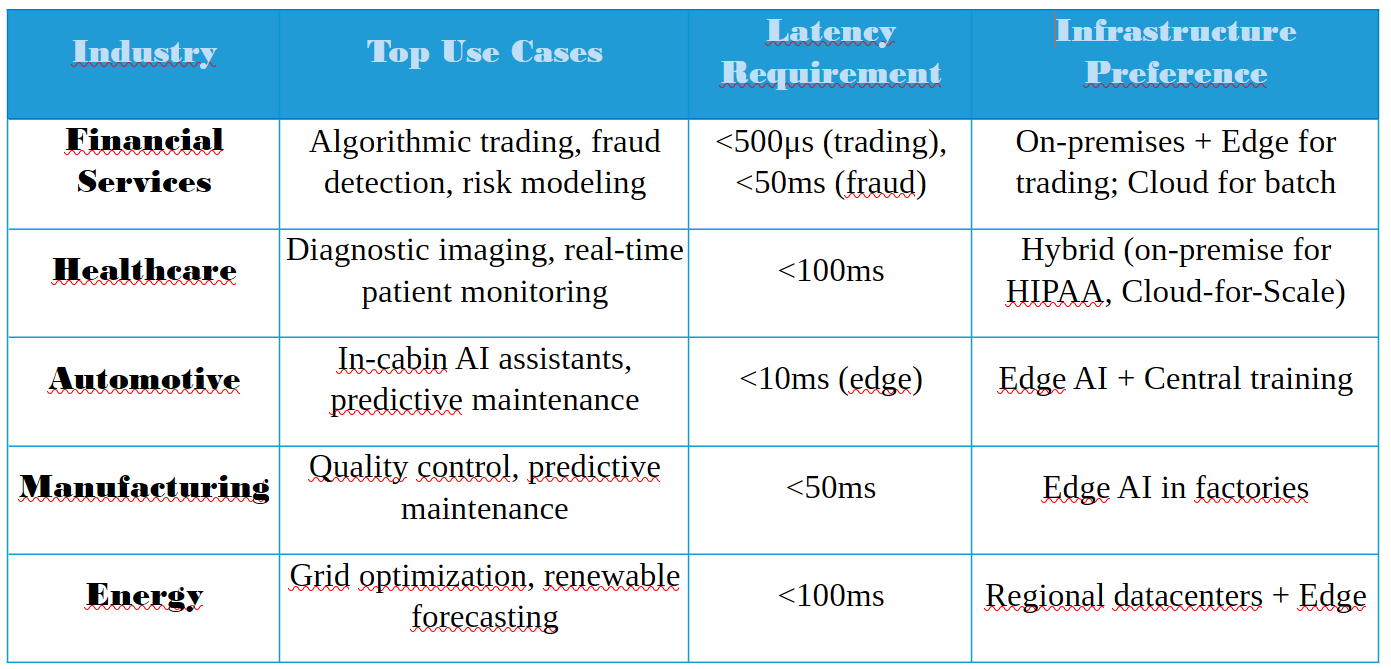
Quantitative Evolution:
-
-
-
Current (2024-2026): Inference represents 40% of AI infrastructure spend
-
Short-term (2027-2028): Inference grows to 58-60% of AI budgets as models move to production
-
Medium-term (2029-2030): 30% of inference workloads shift to edge locations
-
-
Datacenter Practitioner’s View:
Inference is where the real money will be made long-term. While training grabs headlines, inference workloads will dominate infrastructure spending by 2027. The winners won’t be those with the most GPUs, but those who optimize for cost-per-inference and tokens-per-megawatt. I’m particularly bullish on specialized inference ASICs (like Groq’s TSP and AWS Inferentia) for specific workloads—they can deliver 5-10x better price-performance than general-purpose GPUs for the right use cases.
3. High-Performance Computing (HPC) & Scientific Simulations
Workload Characteristics:
-
-
-
Compute Pattern: Batch processing with high inter-node communication (MPI)
-
Hardware: Hybrid CPU+GPU clusters; specialized accelerators (Cerebras WSE for very large models)
-
Storage: Parallel file systems (Lustre, BeeGFS) with NVMeoF
-
Networking: Low-latency InfiniBand or RoCE
-
-
Industry Applications:
-
-
-
Life Sciences: Genomic sequencing, protein folding (AlphaFold), clinical trial optimization
-
Energy: Climate modeling, seismic analysis, fusion research (ITER plasma control)
-
Automotive: Digital twins, virtual crash testing, computational fluid dynamics
-
Financial Services: Monte Carlo simulations for risk modeling
-
-
Quantitative Benchmarks:
-
-
-
Genomic analysis: 10,000+ CPU cores + GPU acceleration
-
Climate modeling: 50-100 MW facilities running continuously
-
Compute time reduction: 50-90% vs. non-optimized clusters
-
-
4. Virtual Desktop Infrastructure (VDI) & GPU-Accelerated Workstations
Workload Characteristics:
-
-
-
Use Case: Remote access to GPU-accelerated desktops for designers, engineers, data scientists
-
Hardware: Desktop-grade GPUs (NVIDIA L4, A10, specialized vGPU instances)
-
Density: 16+ users per high-end GPU for task workers; ~4 users for power users
-
-
Industry Applications:
-
-
-
Manufacturing: CAD/CAM design, 3D modeling
-
Media & Entertainment: Video editing, rendering, VFX
-
Life Sciences: Molecular visualization, research collaboration
-
-
The Power & Cooling Imperative
The shift to AI workloads has fundamentally changed data center design parameters. Here are the hard constraints we’re designing against:
Power Density Evolution
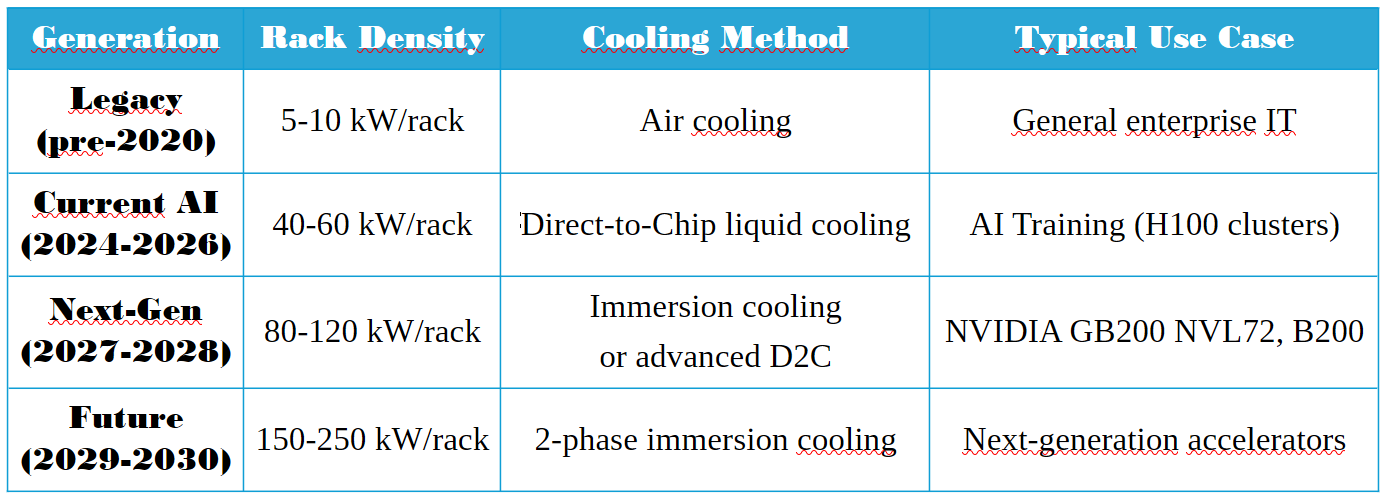
Critical Infrastructure Requirements:
-
-
Power Availability: Securing grid connections now takes 4+ years in primary markets (Northern Virginia, Amsterdam, Frankfurt). This is the #1 bottleneck for new builds.
-
Cooling Technology:
-
Air cooling becomes inadequate above 20 kW/rack
-
Direct-to-chip liquid cooling is 3,000x more efficient than air for AI hardware
-
Immersion cooling adoption projected to reach 40% of new builds by 2027
-
-
PUE Targets:
-
Traditional data centers: 1.5-1.8
-
Modern AI facilities: 1.15-1.25
-
Immersion-cooled facilities: 1.05-1.12
-
-
Datacenter Practitioner’s View:
Power, not GPUs, is the true constraint in AI infrastructure. I’ve seen projects delayed 18+ months waiting for substation upgrades. Organizations must engage utilities 24-36 months before planned deployment. Additionally, liquid cooling is no longer optional for competitive AI facilities—any new build not designed for 80+ kW/rack density will be obsolete before completion.
Capacity Dimensioning:
Capacity Dimensioning: Characteristics of a “Mid-Sized” AI Datacenter
For context, let’s define typical AI datacenter scales:
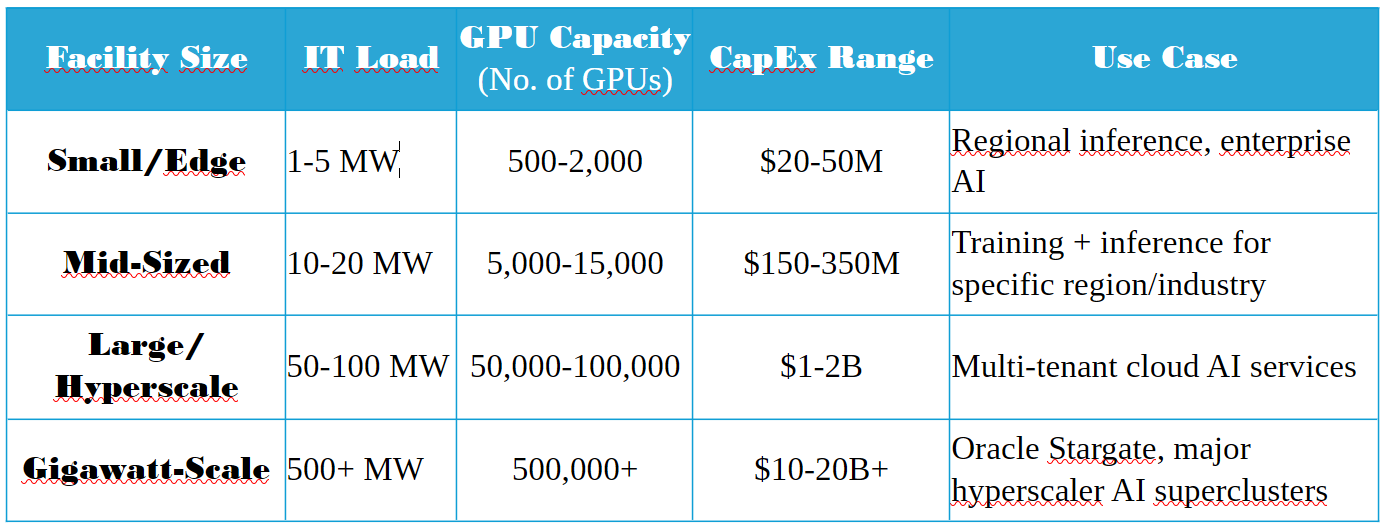
Example:
Oracle’s partnership with OpenAI and SoftBank (Stargate initiative) targets 4.5 GW of AI compute capacity in the U.S. alone representing ~$300B in total investment over multiple years.
Time to Market: The Build-Out Reality
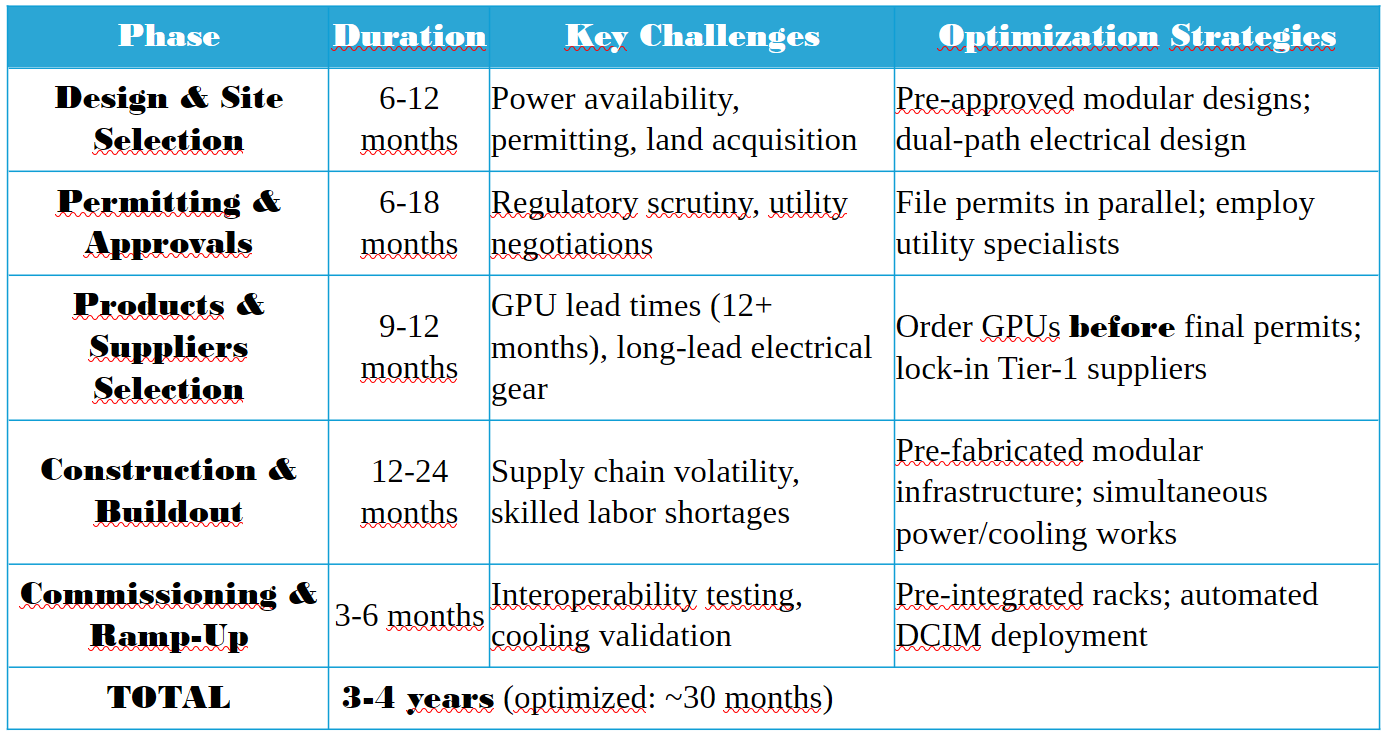
Based on my experience delivering 15+ AI datacenter projects, here are realistic timelines:
Mid-Sized AI Datacenter (10-20 MW):
Datacenter Practitioner’s View:
The critical path isn’t construction—it’s power procurement and GPU allocation. I’ve reduced project timelines by 6 months by ordering long-lead equipment (transformers, chillers, GPUs) before permits were finalized. This carries risk but is necessary to compete in this market. Additionally, modular construction can cut build time by 30-40%, but requires upfront capital commitment and design standardization.
Cost Benchmarks: The Economics of AI Infrastructure
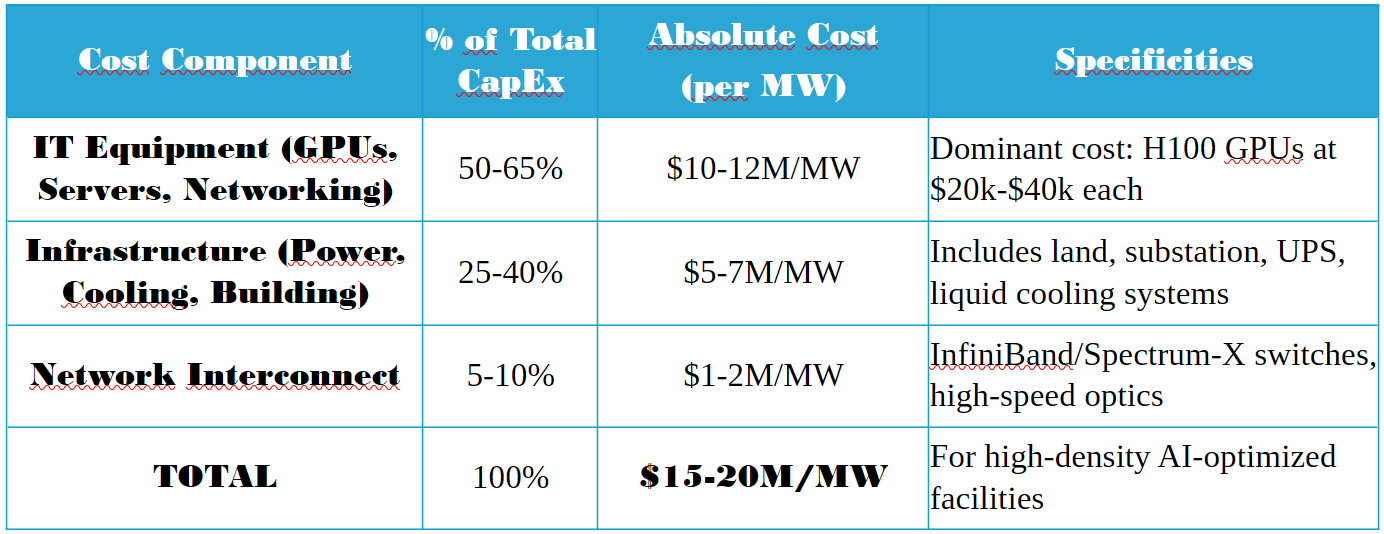
CapEx Breakdown (Mid-Sized AI Datacenter):
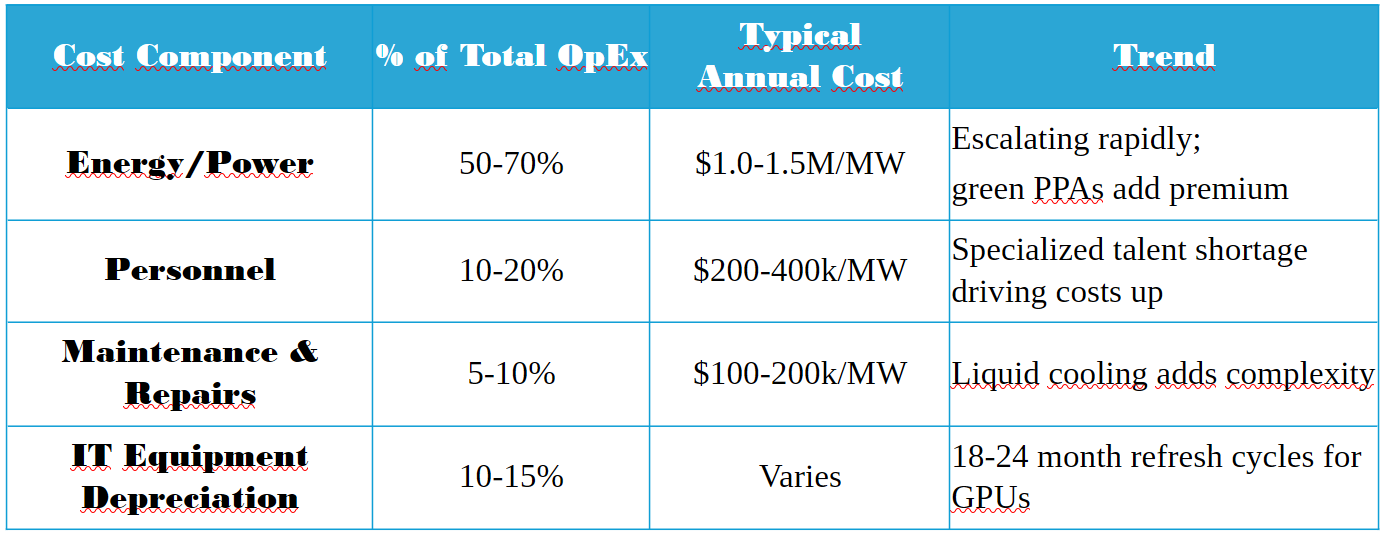
OpEx Breakdown (Annual):
Cost per GPU Rack Example:
A single fully loaded AI rack (8-node GPU cluster, 60 kW load) represents:
-
-
-
IT Equipment: $500k-$1M (GPUs alone)
-
Infrastructure Share: $200-400k
-
Total: $700k-$1.4M per rack
-
-
Datacenter Practitioner’s View:
The CapEx per teraFLOP will decrease through 2030 due to Moore’s Law and chip efficiency gains. However, absolute CapEx will increase as facilities grow larger and power/cooling costs rise. The real OpEx battleground is energy—organizations achieving PUE <1.15 and securing renewable PPAs at <$80/MWh will have 30-40% lower operating costs than competitors. This is where European facilities (with hydro/nuclear power) have a structural advantage over U.S. counterparts.
Emerging Technology Trends Shaping the Next Decade
1. Sovereign AI & Data Locality
-
-
-
Trend: Nations requiring AI infrastructure within borders (EU AI Act, data sovereignty laws)
-
Impact: Driving demand for regional datacenters in Germany, Netherlands, France
-
Oracle Example: $3B investment in Germany & Netherlands over 5 years
-
-
2. Edge AI Proliferation
-
-
-
Trend: 30% of inference workloads moving to edge by 2027
-
Use Cases: Smart factories, autonomous vehicles, real-time healthcare monitoring
-
Infrastructure: Micro-datacenters (5-10 kW racks) with 5G backhaul
-
-
3. Small Modular Reactors (SMRs) for Datacenter Power
-
-
-
Trend: SMRs emerging as viable clean energy solution for gigawatt-scale facilities
-
Timeline: Commercial deployment expected ~2030 in U.S.
-
Impact: Could provide 300 MW baseload power, reducing grid dependence
-
-
4. Composable Infrastructure & CXL
-
-
-
Trend: Dynamic resource allocation using Compute Express Link (CXL)
-
Benefit: Improved GPU utilization (target 80%+ vs. current 40-60%)
-
Timeline: Widespread adoption 2026-2028
-
-
5. Multi-Vendor Silicon Strategies
-
-
-
Trend: Organizations diversifying beyond NVIDIA (AMD MI300X, Intel Gaudi, custom ASICs)
-
Driver: Supply chain risk, cost optimization, workload-specific optimization
-
My View: By 2028, leading AI facilities will run heterogeneous GPU/accelerator pools orchestrated by intelligent schedulers.
-
-
Summary Tables: Key Benchmarks & KPIs
Table 1: AI Workload Infrastructure Requirements
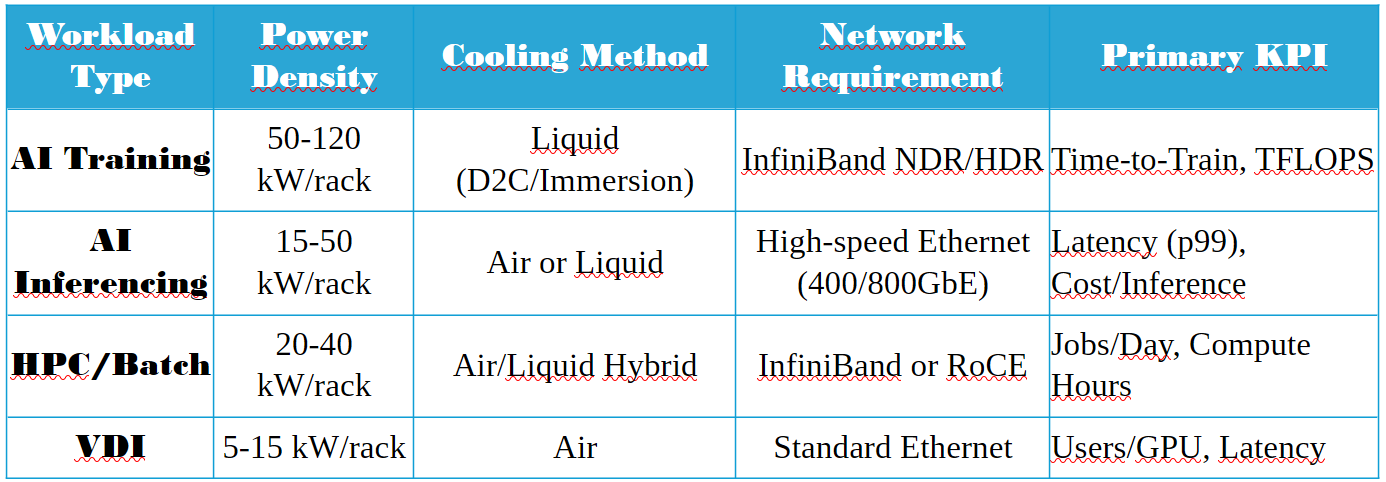
Table 2: Evolution of AI Infrastructure Demand (2024-2030)
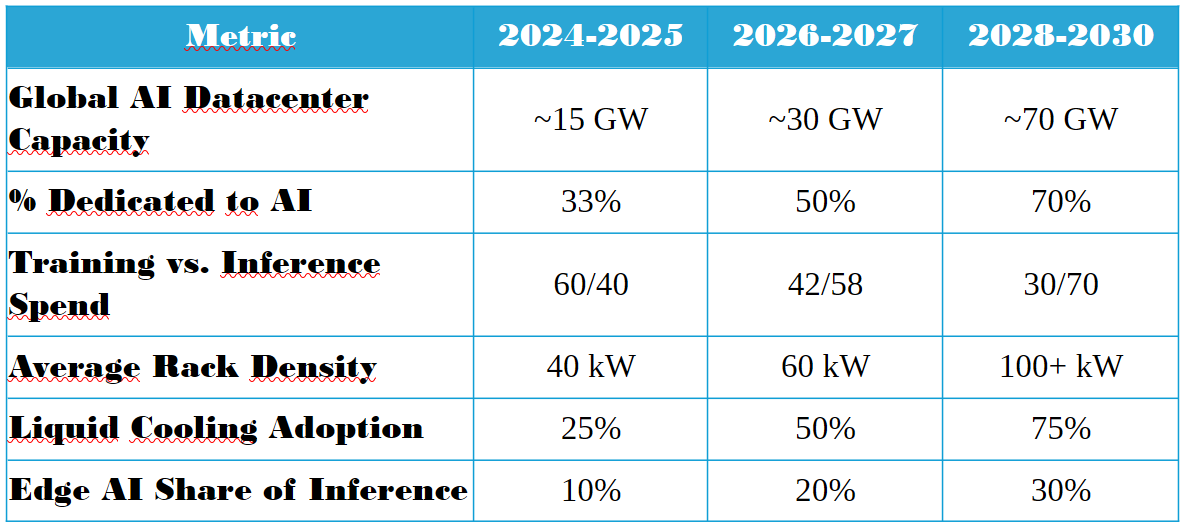
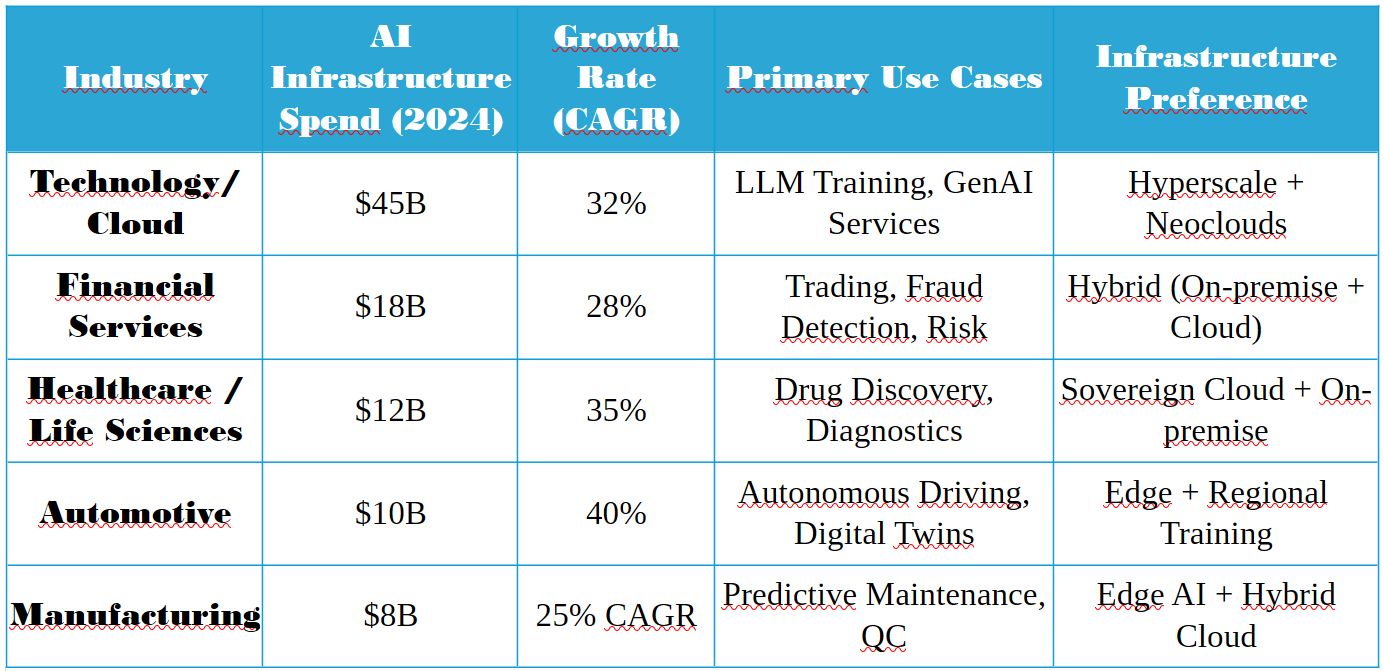
Table 3: Priority Industries for AI Infrastructure Investment
Looking Ahead: What’s Next in This Series
In the second article, we’ll dive deep into the competitive landscape, analyzing:
-
-
-
Hyperscalers (AWS, Azure, Google Cloud, Oracle): Their AI infrastructure strategies, market share, and competitive positioning.
-
Neoclouds & GPUaaS Providers (CoreWeave, Lambda Labs, Scaleway, Nebius, Crusoe): How these agile players are disrupting the market with specialized offerings.
-
Colocation Providers (Equinix, Digital Realty, NTT): Their evolving role as the “landlords” of the AI race.
-
SWOT Analysis: Structured comparison of each player type with “who-wins-where” scenarios.
-
Market Dynamics: Short-term (2028) and mid-term (2030) evolution forecasts.
-
-
In the third article, we’ll examine the technical architecture in detail:
-
-
-
Rack-Level Design: Hybrid GPU/accelerator configurations, memory hierarchies (HBM4, LPDDR5, SOCAMM2).
-
Silicon Wars: NVIDIA vs. AMD vs. Intel vs. specialized ASICs (Cerebras, Groq, Graphcore, AWS Trainium/Inferentia).
-
Networking Fabric: Ultra-low latency switches (Cisco, NVIDIA, Broadcom), InfiniBand vs. Ethernet, the Ultra Ethernet Consortium.
-
Power & Cooling Technologies: Direct-to-chip, immersion cooling, waste heat recovery.
-
Board-Level Innovations: Co-packaged optics, CXL memory expansion, next-gen interconnects.
-
-
Final Takeaways
The AI infrastructure market is experiencing unprecedented growth, but it’s not without challenges. Power availability, supply chain constraints, and talent shortages are the three biggest bottlenecks I see in my projects. Organizations must think strategically about:
-
-
-
Workload Mix: Balance training and inference capabilities to avoid stranded assets.
-
Geographic Strategy: Prioritize locations with power availability over traditional hubs.
-
Technology Flexibility: Design for heterogeneous accelerator pools, not just NVIDIA.
-
Sustainability: Secure renewable PPAs early—this will be a competitive advantage by 2027.
-
Partnership Model: Consider hybrid approaches (hyperscaler + neocloud + colocation) rather than single-vendor lock-in.
-
-
The winners in this market won’t be those who build the biggest facilities, but those who optimize for Tokens-per-Megawatt, Cost-per-Inference, and Workload Flexibility.
References & Further Reading
-
-
Uptime Institute. “Global Data Center Survey 2023.” https://journal.uptimeinstitute.com/uptime-institute-global-data-center-survey-2023/
-
Gartner. “AI Infrastructure Outlook 2024.” https://www.gartner.com/en/information-technology/insights/artificial-intelligence
-
McKinsey. “Data Center Growth in the Age of AI.” https://www.mckinsey.com/industries/technology-media-and-telecommunications/our-insights/data-center-growth
-
Data Center Dynamics. “Trend Report: Data Centres in the Age of AI.” March 28, 2025. https://datacentrereview.com/2025/03/trend-report-data-centres-in-the-age-of-ai/
-
PwC. “Data Centers at the Crossroads of Technology and Resilience.” February 25, 2025. https://www.pwc.com/us/en/industries/tmt/library/hyperscale-data-center.html
-
Oracle. “Oracle Cloud Infrastructure AI Infrastructure Buildout.” https://www.oracle.com/news/announcement/oracle-accelerates-data-center-builds-20230815/
-
Reuters. “Oracle Expects Cloud Infrastructure Revenue to Be $166B by FY30.” October 16, 2025. https://www.reuters.com/technology/oracle-expects-cloud-infrastructure-revenue-be-166-bln-fy30-2025-10-16/
-
arXiv. “Short-Term Load Forecasting for AI-Data Center.” March 10, 2025. https://arxiv.org/html/2503.07756v1
-
Epoch AI. “How Much Energy Does ChatGPT Use?” February 7, 2025. https://epoch.ai/gradient-updates/how-much-energy-does-chatgpt-use
-
Schneider Electric. “The Current and Future Path to AI Inference Data Center Optimization.” May 8, 2025. https://blog.se.com/datacenter/2025/05/08/the-current-and-future-path-to-ai-inference-data-center-optimization/
-
JLL. “2025 Data Center Outlook.”
-
Synergy Research. “Cloud Market Share Q1 2024.” https://www.srgc.com/cloud-market-share-q1-2024/
-
About the Author:
As a Data & AI Infrastructure Expert, I’ve led 15+ “Design-Build-Operate” projects for AI datacenters across Life Sciences, Automotive, Energy, and Banking sectors. I’ve evaluated principal Neoclouds/GPUaaS providers (CoreWeave, Lambda Labs, Scaleway, Nebius, Crusoe) and colocation providers (Equinix, Digital Realty, NTT), benchmarked various accelerators (NVIDIA H200/B200, AMD MI300X, Intel Gaudi, Cerebras, Groq), and partnered with hyperscalers (Azure, Google Cloud, AWS, OCI) to architect and deliver high-density AI infrastructure. Earlier at Qualcomm, I created and developed a full-service Profit Center (150 FTEs) for end-to-end semiconductor design-validation-testing of AI/HPC accelerators and ultra-fast networking infrastructure.
Next Article Preview:
Ready to understand who’s winning the AI infrastructure race? In Article 2, we’ll analyze the competitive strategies of hyperscalers, neoclouds, and colocation providers with detailed SWOT analyses and market share data. [Subscribe to get notified when Article 2 publishes.]