
The Technical Architecture: Inside AI Datacenters – Racks, Accelerators, Memory, and Networking
Introduction: Engineering the AI Factory
-
- Rack-Level Design: Power densities from 40 kW to 250 kW, liquid cooling imperatives, and training vs. inference configurations
- Accelerator Wars: Detailed comparison of NVIDIA H200/B200, AMD MI300X/MI450, Intel Gaudi, Cerebras WSE, Groq TSP, and AWS Trainium/Inferentia
- Memory Hierarchies: HBM4, LPDDR5, SOCAMM2—when to use each and why memory power is becoming a first-order constraint
- Networking Fabric: InfiniBand vs. Spectrum-X Ethernet, 51.2T vs. 102.4T switches, and the Ultra Ethernet Consortium’s impact
- Power & Cooling: Direct-to-chip liquid cooling, immersion cooling, power capacitance shelves, and waste heat recovery
Part 1: Rack-Level Architecture Design
The Power Density Revolution
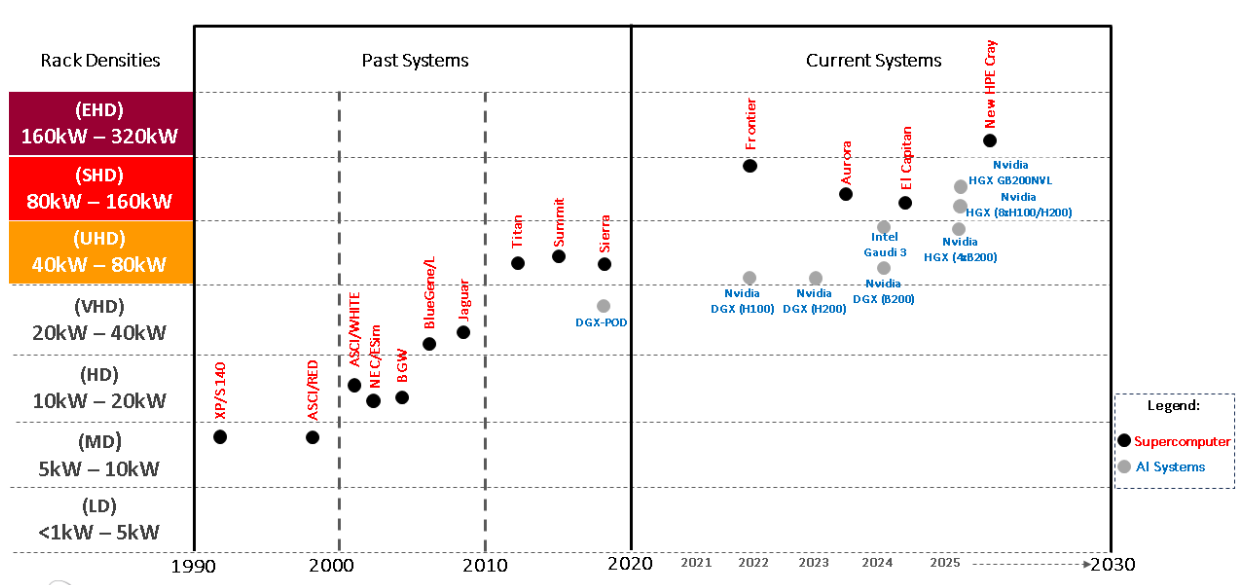
Rack Density Evolution by Generation:
|
Generation
|
Typical Density
|
Cooling Method
|
Example System
|
|---|---|---|---|
|
Legacy (2020-2022)
|
10-20 kW/rack
|
Air cooling
|
NVIDIA DGX A100 (partial air)
|
|
Current (2023-2025)
|
40-80 kW/rack
|
Direct-to-chip liquid
|
NVIDIA HGX H100 8-GPU
|
|
Next-Gen (2025-2027)
|
80-120 kW/rack
|
Advanced D2C + rear-door
|
NVIDIA GB200 NVL72
|
|
Future (2028-2030)
|
150-250 kW/rack
|
Two-phase immersion
|
Next-gen Blackwell/Rubin
|
AI Practitioner’s View: Any new AI data center build not designed for minimum 80 kW/rack is obsolete before completion. I’ve seen clients try to “save money” by designing for 40 kW/rack, only to face $5M+ retrofit costs 18 months later when NVIDIA GB200 systems arrive. Design for the next-next generation, not the current one.
Cooling Technologies: The Liquid Imperative
1. Direct-to-Chip (D2C) Liquid Cooling
-
- Cooling Capacity: 700W-1,500W per GPU
- Flow Rate: 2-4 liters/minute per rack
- Temperature Delta: 10-15°C between inlet/outlet
- PUE Impact: Reduces PUE from 1.5 to 1.15-1.20
-
- Compatible with standard 19″ racks
- 3,000x more efficient than air cooling
- Lower CapEx than immersion ($2-3M/MW vs. $4-5M/MW)
- Easier maintenance (hot-swappable cold plates)
-
- Requires Cooling Distribution Units (CDUs)
- Plumbing complexity (leak detection critical)
- Limited to ~100 kW/rack maximum
2. Immersion Cooling
-
- Cooling Capacity: Up to 200 kW/rack
- Fluid Types: Single-phase (mineral oil) or two-phase (evaporative)
- PUE: 1.05-1.12 (best-in-class)
- Heat Recovery: 60-80°C fluid enables district heating integration
-
- Highest cooling efficiency
- Eliminates fans (reduces noise, vibration, maintenance)
- Extends hardware lifespan (no dust, thermal cycling)
- Enables extreme densities (150-250 kW/rack)
-
- High CapEx ($4-5M/MW)
- Proprietary tank systems (vendor lock-in)
- Fluid cost ($50-100/liter, requires periodic replacement)
- Maintenance complexity (requires fluid handling expertise)
AI Practitioner’s View:
Immersion cooling is the future, but D2C is the present. For mid-sized facilities (10-50 MW), D2C offers the best balance of performance and cost. For hyperscalers building 100+ MW campuses, immersion cooling’s superior PUE and heat recovery capabilities justify the CapEx premium. I recommend a hybrid approach: D2C for 70% of racks, immersion for the densest 30%.
3. Rear-Door Heat Exchangers (RDHx)
-
- Cooling Capacity: 30-60 kW/rack
- Hybrid Approach: Often combined with D2C for 80-100 kW/rack
- Retrofit Friendly: Can upgrade existing air-cooled racks
Rack Configurations: Training vs. Inference
|
Feature
|
AI Training Racks
|
AI Inference Racks
|
|---|---|---|
|
Power Density
|
60-120 kW/rack
|
15-50 kW/rack (up to 80 kW for LLM inference)
|
|
GPU Configuration
|
8-16 GPUs/server (HGX/DGX)
|
1-4 GPUs/server (L40S, L4, repurposed A100)
|
|
Networking
|
InfiniBand NDR/HDR (non-blocking)
|
High-speed Ethernet (400/800GbE)
|
|
Cooling
|
D2C liquid or immersion
|
Air or RDHx (D2C for high-density LLM)
|
|
Storage
|
Parallel file systems (Lustre, BeeGFS)
|
Fast NVMe for model loading
|
|
Memory
|
HBM3/HBM4 (80-192GB/GPU)
|
HBM3 or GDDR6 (cost-optimized)
|
|
Utilization Pattern
|
Sustained 90%+ for days/weeks
|
Bursty, 30-60% average
|
|
Key KPI
|
Time-to-Train, TFLOPS
|
Latency (p99), Cost/Inference
|
AI Practitioner’s View:
Don’t make the mistake of using training racks for inference. It’s like using a Formula 1 car for grocery shopping—overkill on performance, terrible on economics. Inference racks should prioritize cost-per-inference and power efficiency, not raw TFLOPS. Conversely, don’t try to run large-scale training on inference-optimized racks—the network fabric will bottleneck you immediately.
Power Capacitance Shelves & Peak Load Shaving
|
Workload
|
Base Load
|
Peak Load
|
Variability Frequency
|
|---|---|---|---|
|
AI Training
|
25-30 MW/facility
|
45 MW (50% surge)
|
Every 2-4 hours (batch jobs)
|
|
LLM Inference
|
5-10 MW/facility
|
12 MW (spikes)
|
Seconds-minutes (user traffic)
|
|
HPC Batch
|
15-20 MW/facility
|
28 MW
|
Every 6-12 hours
|
- Capacity: 100-500 kWh per rack/row
- Response Time: <10 milliseconds
- Use Case: Training racks (mandatory), high-volume LLM inference (recommended)
- Prevents voltage sags and grid instability
- Reduces peak demand charges (can save $500k-$2M/year)
- Extends UPS lifespan (fewer deep discharge cycles)
- Enables higher rack densities without grid upgrades
Part 2: AI Accelerators Deep Dive
The Accelerator Landscape: Beyond NVIDIA
NVIDIA GPUs: The Gold Standard
NVIDIA H200 (Hopper Architecture)
- FP8 Performance: 3,958 TFLOPS (with sparsity)
- FP16/BF16: 1,979 TFLOPS
- Memory: 141 GB HBM3 @ 4.8 TB/s bandwidth
- TDP: 700W
- Interconnect: NVLink 4.0 (900 GB/s), PCIe 5.0
- Price: $25,000-$40,000 per GPU
- Mature software ecosystem (CUDA, cuDNN, TensorRT)
- Best-in-class training performance for LLMs
- Multi-Instance GPU (MIG) for inference partitioning
- Transformer Engine for FP8 acceleration
- Premium pricing (2-3x vs. alternatives)
- Supply constraints (12-18 month lead times)
- Power-hungry (700W TDP)
NVIDIA B200 (Blackwell Architecture)
- FP4 Performance: 20,000 TFLOPS (with sparsity)
- FP8 Performance: 10,000 TFLOPS
- Memory: 192 GB HBM3e @ 8 TB/s bandwidth
- TDP: 1,200W (requires liquid cooling)
- Interconnect: NVLink 5.0 (1.8 TB/s)
- Price: $30,000-$50,000 per GPU (estimated)
- 5x performance improvement vs. H100 for inference
- 2x improvement for training
- Second-generation Transformer Engine (FP4 support)
- Confidential computing (encrypted GPU memory)
- Extreme power density (1,200W requires D2C/immersion)
- Availability: Q3 2025+ (limited initial supply)
- Software maturity: CUDA optimizations still rolling out
NVIDIA GB200 NVL72 (Grace-Blackwell Superchip)
- Configuration: 72 Blackwell GPUs + 36 Grace CPUs in single rack
- Aggregate Performance: 720,000 TFLOPS (FP4)
- Memory: 13.8 TB HBM3e (aggregate)
- Power: 120 kW/rack (requires liquid cooling)
- Interconnect: NVLink 5.0 (130 TB/s aggregate bandwidth)
- Rack-scale architecture (eliminates network bottlenecks)
- Best price-performance for large-scale training
- Unified memory across GPUs (simplifies programming)
- Vendor lock-in (proprietary rack design)
- Infrastructure requirements (120 kW/rack, liquid cooling mandatory)
- CapEx: $3-5M per rack
NVIDIA L40S (Inference-Optimized)
- FP16 Performance: 181 TFLOPS
- INT8 Performance: 733 TOPS
- Memory: 48 GB GDDR6 @ 864 GB/s
- TDP: 350W
- Price: $10,000-$15,000
- Cost-effective for inference (50% cheaper than H100)
- Power-efficient (350W vs. 700W)
- AV1 encoding (ideal for video AI)
- PCIe form factor (fits standard servers)
- Lower memory bandwidth (864 GB/s vs. 3.35 TB/s H100)
- Not suitable for large-scale training
Non-GPU Accelerators: The Alternatives
1. AMD Instinct MI Series
- FP16 Performance: 1,307 TFLOPS
- Memory: 192 GB HBM3 @ 5.2 TB/s bandwidth
- TDP: 750W
- Interconnect: Infinity Fabric (896 GB/s), PCIe 5.0
- Price: $15,000-$25,000 (40% cheaper than H100)
- Competitive performance for inference (matches H100 in many workloads)
- Superior memory capacity (192 GB vs. 80 GB H100)
- Open-source software (ROCm avoids CUDA lock-in)
- Better availability (less demand than NVIDIA)
- Software ecosystem maturity lags CUDA (fewer optimized libraries)
- Training performance ~20-30% behind H100 for LLMs
- Enterprise adoption still building momentum
- FP16 Performance: 2,000+ TFLOPS (estimated)
- Memory: 256 GB HBM3e @ 6 TB/s
- TDP: 900W
- Price: $20,000-$30,000 (estimated)
2. Intel Habana Gaudi
- FP16 Performance: 432 TFLOPS
- Memory: 96 GB HBM2e @ 2.4 TB/s
- TDP: 600W
- Interconnect: 21x 100 GbE RoCE (no InfiniBand required)
- Price: $10,000-$15,000
- Best price-performance for training (2-3x better than H100)
- Ethernet-based networking (cheaper than InfiniBand)
- Integrated in AWS (Trainium collaboration)
- Strong for BERT/GPT-style models
- Limited software ecosystem (SynapseAI less mature than CUDA)
- Not suitable for all workloads (performance varies by model)
- Lower brand recognition in enterprise
- FP16 Performance: 1,835 TFLOPS
- Memory: 128 GB HBM2e @ 3.7 TB/s
- TDP: 900W
- Price: $15,000-$20,000
3. Cerebras Wafer-Scale Engine (WSE)
- Architecture: Single wafer-scale chip (46,225 mm²)
- Cores: 900,000 AI-optimized cores
- Memory: 44 GB on-chip SRAM (20 TB/s bandwidth)
- Performance: 1,000+ PFLOPS (sparse)
- Price: $3-5M per system (CS-3)
- Unparalleled performance for very large models (100B+ parameters)
- Eliminates inter-GPU communication (single-chip architecture)
- Simplified programming (no model parallelism required)
- Niche focus (only viable for massive models)
- Extreme cost ($3-5M per system)
- Vendor lock-in (proprietary software stack)
- Infrastructure requirements (specialized cooling, power)
4. Groq Tensor Streaming Processor (TSP)
- Architecture: Deterministic, single-core streaming
- Performance: 1,000+ tokens/sec (Llama 2 70B inference)
- Latency: <10ms p99 (best-in-class)
- Power: 300W
- Price: $15,000-$25,000 (estimated)
- Fastest inference for LLMs (5-10x faster than GPU)
- Deterministic latency (critical for real-time applications)
- Power-efficient (300W vs. 700W GPU)
- No software compilation (runs PyTorch directly)
- Inference-only (cannot train)
- Limited model support (optimized for transformer architectures)
- Newer player (smaller ecosystem)
5. Graphcore Intelligence Processing Unit (IPU)
- Cores: 1,472 independent processor cores
- Memory: 96 MB on-chip SRAM (48 TB/s aggregate)
- Performance: 350 TFLOPS (FP16)
- Architecture: Graph-based, sparse computation
- Excellent for graph neural networks (GNNs)
- Massive parallelism (1,472 cores)
- Efficient for sparse workloads (recommendation systems)
- Different programming paradigm (requires Poplar SDK)
- Limited adoption (niche use cases)
- Not optimized for dense transformer models
6. AWS Trainium & Inferentia
- Performance: 50x price-performance vs. GPU (AWS claim)
- Memory: 128 GB HBM3
- Interconnect: AWS NeuronLink (proprietary)
- Price: Available only on AWS (no bare-metal purchase)
- Performance: 4x throughput vs. GPU for inference
- Latency: 50% lower than GPU
- Price: $0.50-$2.00/hour (on-demand)
- Best price-performance for AWS-native workloads
- Tight integration with AWS services (SageMaker, Bedrock)
- No CapEx (OpEx-only model)
- Vendor lock-in (AWS-only)
- Limited software ecosystem (Neuron SDK vs. CUDA)
- Not portable (cannot migrate to other clouds)
Accelerator Comparative Analysis
|
Accelerator
|
FP16 TFLOPS
|
Memory
|
TDP
|
Price
|
Price/TFLOPS
|
Best Use Case
|
|---|---|---|---|---|---|---|
|
NVIDIA H200
|
1,979
|
141 GB HBM3
|
700W
|
$30k
|
$15.16/TFLOPS
|
Frontier LLM training
|
|
NVIDIA B200
|
~4,000
|
192 GB HBM3e
|
1,200W
|
$40k
|
$10.00/TFLOPS
|
Next-gen training
|
|
AMD MI300X
|
1,307
|
192 GB HBM3
|
750W
|
$20k
|
$15.30/TFLOPS
|
Large-context inference
|
|
Intel Gaudi 3
|
1,835
|
128 GB HBM2e
|
900W
|
$18k
|
$9.81/TFLOPS
|
Budget training
|
|
Cerebras WSE-3
|
~1,000,000
|
44 GB SRAM
|
20kW
|
$4M
|
$4.00/TFLOPS
|
Massive model training
|
|
Accelerator
|
Throughput
|
Latency (p99)
|
Power
|
Cost/Inference
|
Best Use Case
|
|---|---|---|---|---|---|
|
NVIDIA L40S
|
1,000 inferences/sec
|
50ms
|
350W
|
$0.0001
|
General inference
|
|
Groq TSP
|
5,000 inferences/sec
|
<10ms
|
300W
|
$0.00002
|
Real-time LLM
|
|
AWS Inferentia2
|
2,000 inferences/sec
|
30ms
|
250W
|
$0.00005
|
AWS-native inference
|
|
AMD MI300X
|
800 inferences/sec
|
80ms
|
750W
|
$0.00015
|
Large-context RAG
|
SWOT Analysis: GPU vs. Non-GPU Accelerators
|
Category
|
NVIDIA GPUs
|
AMD Instinct
|
Intel Gaudi
|
Custom ASICs (Trainium/Groq)
|
|---|---|---|---|---|
|
Strengths
|
• Mature CUDA ecosystem
• Best training performance • Broad software support • Multi-generational roadmap |
• Competitive pricing
• Large memory capacity • Open-source ROCm • Good availability |
• Best price-performance
• Ethernet-based (no InfiniBand) • AWS integration |
• Superior price-performance
• Workload-specific optimization • Power efficiency |
|
Weaknesses
|
• Premium pricing
• Supply constraints • High power consumption • Vendor lock-in risk |
• Software ecosystem maturity
• Training performance gap • Lower enterprise adoption |
• Limited software ecosystem
• Workload-dependent performance • Brand recognition |
• Vendor lock-in (extreme)
• Limited workload support • Portability challenges |
|
Opportunities
|
• B200/GB200 launch
• Sovereign AI demand • Inference market growth • Edge AI expansion |
• Inference market share gain
• EU sovereignty push • HPC convergence • ROCm adoption |
• Cost-sensitive training
• AWS partnership expansion • Enterprise AI adoption |
• Hyperscaler custom silicon
• Specialized workloads • Edge AI proliferation |
|
Threats
|
• AMD/Intel competition
• Custom silicon disruption • Regulatory scrutiny • Export restrictions (China) |
• NVIDIA price cuts
• Software ecosystem gap • Execution risk |
• NVIDIA/AMD dominance
• Software investment requirements • Market share stagnation |
• Hyperscaler dependency
• Workload evolution • Competition from GPUs |
Part 3: Memory Hierarchies & Technologies
Memory: The Hidden Bottleneck
- HBM4 (High Bandwidth Memory): 2-3 kW per stack
- LPDDR5: 500W-1 kW per module
- Total Memory Power: 20-30% of rack power budget (up from 10% in 2020)
HBM (High Bandwidth Memory): The Training Standard
HBM3 (Current Generation)
- Bandwidth: 3.35 TB/s (NVIDIA H100), 5.2 TB/s (AMD MI300X)
- Capacity: 80-192 GB per GPU
- Power: 2-3 kW per stack
- Cost: $500-$1,000 per GB (estimated)
- AI Training (mandatory for large models)
- High-performance Inference (large context windows)
- Highest bandwidth (10x GDDR6)
- 3D stacking (vertical integration saves space)
- Low latency (on-package integration)
- Extreme cost ($500-$1,000/GB)
- Supply constraints (SK Hynix, Samsung, Micron only)
- High power consumption (2-3 kW per stack)
HBM4 (Next Generation, 2026-2027)
- Bandwidth: 8-10 TB/s (estimated)
- Capacity: 256-512 GB per GPU
- Power: 3-4 kW per stack
- Process: 12-layer stacking (vs. 8-layer HBM3)
- 2x bandwidth vs. HBM3
- 2x capacity (enables 1M+ token contexts)
- Better power efficiency (bandwidth per watt)
- Availability: Q4 2026+ (limited initial supply)
- Cost: $1,000-$1,500/GB (estimated)
- Thermal challenges (higher power density)
LPDDR5 & SOCAMM2: The Efficiency Play
LPDDR5 (Low Power DDR5)
- Bandwidth: 6.4-8.5 GB/s per pin
- Capacity: 16-64 GB per module
- Power: 10-15W per 16 GB module
- Cost: $50-$100 per GB
- Edge AI (power-constrained environments)
- Inference accelerators (Groq, AWS Inferentia)
- x86 AI servers (Intel/AMD CPUs with integrated AI)
- Power efficiency (10x better than HBM)
- Lower cost ($50-100/GB vs. $500-1,000/GB HBM)
- Standard form factor (easy to upgrade)
- Lower bandwidth (100x less than HBM)
- Higher latency (off-package vs. on-package)
- Not suitable for large-scale training
SOCAMM2 (Small Outline CAMM2)
- Standard: JEDEC JESD328 (2024)
- Bandwidth: 8-12 GB/s per pin
- Capacity: 32-128 GB per module
- Power: 15-20W per module
- Form Factor: 50% smaller than traditional DIMMs
- AI host nodes (x86 servers with AI accelerators)
- Dense power-constrained servers
- CXL memory expansion (capacity tier)
- Compact design (enables higher server density)
- Better power efficiency vs. traditional DDR5
- Standardization (multi-vendor ecosystem forming)
- Emerging standard (limited availability in 2024-2025)
- Higher cost than traditional DIMMs (early adopter premium)
- Requires new server designs (not backward compatible)
Memory Adoption Scenarios: Pragmatic Roadmap
- LPDDR5 dominates non-x86 platforms (NVIDIA Grace/Vera, ARM-based AI accelerators)
- HBM3 remains standard for AI training
- GDDR6 sufficient for cost-sensitive inference
- x86 adoption of LPDDR5/SOCAMM2 becomes realistic IF:
- Multi-vendor ecosystem develops (Intel, AMD, Samsung, Micron)
- Server memory controllers support LPDDR broadly
- Data center clients accept new operational model
- HBM4 becomes standard for frontier training
- SOCAMM2 adopted for AI host nodes and CXL memory expansion
- Hybrid memory architectures (HBM4 + LPDDR5 + CXL) become standard
- Memory tiering orchestrated by AI schedulers
- Memory power becomes primary constraint (not bandwidth)
|
Technology
|
Bandwidth
|
Capacity
|
Power
|
Cost
|
Best Use Case
|
|---|---|---|---|---|---|
|
HBM4
|
8-10 TB/s
|
256-512 GB
|
3-4 kW
|
$1,000-1,500/GB
|
Frontier LLM training
|
|
HBM3
|
3-5 TB/s
|
80-192 GB
|
2-3 kW
|
$500-1,000/GB
|
AI training, large-context inference
|
|
GDDR6
|
800 GB/s – 1.5 TB/s
|
16-48 GB
|
300-500W
|
$50-100/GB
|
General inference
|
|
LPDDR5
|
6.4-8.5 GB/s/pin
|
16-64 GB
|
10-15W/module
|
$50-100/GB
|
Edge AI, inference accelerators
|
|
SOCAMM2
|
8-12 GB/s/pin
|
32-128 GB
|
15-20W/module
|
$75-150/GB
|
AI host nodes, CXL expansion
|
CXL (Compute Express Link): The Future of Memory Expansion
- Type 3 Devices: Memory expanders (SSD-like form factor, DRAM-like performance)
- Capacity: 1-8 TB per device
- Latency: 500-800 ns (vs. 100 ns for local DRAM)
- Bandwidth: 32-64 GB/s (PCIe 5.0 x16)
- Memory pooling (share memory across GPU cluster)
- Capacity expansion (add TBs of memory without adding GPUs)
- Cost optimization (cheaper than HBM for capacity tier)
Part 4: Ultra-Low Latency Networking
The Network Fabric: Make or Break for AI Training
|
Workload
|
Bandwidth
|
Latency
|
Topology
|
Protocol
|
|---|---|---|---|---|
|
AI Training (Large-Scale)
|
400-800 Gbps/node
|
<1 μs
|
Non-blocking fat-tree
|
InfiniBand NDR/HDR
|
|
AI Training (Mid-Scale)
|
200-400 Gbps/node
|
<2 μs
|
Oversubscribed (2:1)
|
InfiniBand or RoCE
|
|
AI Inference
|
100-200 Gbps/node
|
<10 μs
|
Standard leaf-spine
|
Ethernet (400/800GbE)
|
|
HPC Batch
|
100-200 Gbps/node
|
<5 μs
|
Fat-tree
|
InfiniBand or RoCE
|
InfiniBand vs. Ethernet: The Great Debate
InfiniBand (NVIDIA Mellanox)
- Bandwidth: 400 Gbps per port (NDR), 800 Gbps (NDR2x)
- Latency: <600 ns (best-in-class)
- Topology: Non-blocking fat-tree (requires high radix switches)
- Protocol: Native InfiniBand (not IP-based)
- Lowest latency (critical for tightly-coupled training)
- RDMA (Remote Direct Memory Access) (bypasses CPU)
- Adaptive routing (avoids congestion)
- Proven at scale (100,000+ GPU clusters)
- Vendor lock-in (NVIDIA dominates 90% market)
- Higher cost ($500k-$1M per rack for switches/cables)
- Complexity (requires InfiniBand expertise)
- Not IP-native (separate network from storage/management)
- Bandwidth: 800 Gbps per port
- Latency: <400 ns
- Availability: Q2 2025 (limited), Q4 2025 (general)
- Price: $10,000-$15,000 per port (estimated)
Ethernet (RoCE – RDMA over Converged Ethernet)
- Bandwidth: 400 Gbps (400GbE), 800 Gbps (800GbE)
- Latency: <2 μs (with RoCE v2)
- Protocol: IP-based (standard Ethernet)
- Standards: IEEE 802.3bs (400GbE), 802.3df (800GbE)
- Lower cost ($200k-$500k per rack vs. $500k-$1M InfiniBand)
- IP-native (unified network for compute, storage, management)
- Multi-vendor ecosystem (Arista, Cisco, Juniper, white-box)
- Easier to manage (familiar Ethernet tooling)
- Higher latency (2 μs vs. 600 ns InfiniBand)
- Congestion management (requires careful tuning)
- Not as proven at 100,000+ GPU scale
Spectrum-X Ethernet (NVIDIA’s Answer to InfiniBand)
- Bandwidth: 400/800 Gbps
- Latency: <1 μs (approaching InfiniBand)
- Congestion Control: AI-driven (machine learning-based)
- Integration: Tight coupling with NVIDIA GPUs
- Near-InfiniBand performance with Ethernet flexibility
- Unified network (AI + storage + management)
- Lower cost than InfiniBand
- NVIDIA ecosystem (optimized for CUDA, NCCL)
- Vendor lock-in (NVIDIA-specific)
- Newer technology (less proven at scale)
- Requires NVIDIA BlueField DPUs (additional cost)
Switch Technologies: 51.2T and 102.4T Generations
51.2 Tbps Switch Generation (Current High-End)
- Capacity: 51.2 Tbps aggregate
- Ports: 64x 800 Gbps or 128x 400 Gbps
- Power: 1,200W per ASIC
- Use Cases: Hyperscaler AI clusters, large-scale training
- Dominant merchant silicon (70%+ market share)
- Cost-effective (vs. proprietary ASICs)
- SONiC support (open-source NOS)
- Multi-vendor ecosystem (Arista, Celestica, Delta)
- Not AI-optimized (general-purpose merchant silicon)
- Requires tuning for AI workloads (congestion control)
- Capacity: 51.2 Tbps aggregate
- Ports: 64x 800 Gbps
- Power: 1,400W per switch
- Integration: Spectrum-X AI platform
- AI-optimized (congestion control, adaptive routing)
- Tight NVIDIA GPU integration
- Proven at scale (100,000+ GPU deployments)
- Vendor lock-in (NVIDIA ecosystem)
- Higher cost (vs. Tomahawk-based white-box)
- Capacity: 51.2 Tbps aggregate
- Ports: 64x 800 Gbps
- Power: 1,300W per ASIC
- Platform: Nexus 9000 series
- Programmable ASIC (custom-tuned performance)
- Full-stack portfolio (compute, security, observability)
- Enterprise focus (robust security, compliance)
- UEC leadership (Ultra Ethernet Consortium co-founder)
- Higher cost (vs. merchant silicon)
- Smaller AI ecosystem (vs. NVIDIA)
102.4 Tbps Switch Generation (Next-Gen, 2026-2027)
- Port Speed: 1.6 Tbps per port (200G lanes)
- Technology: Co-Packaged Optics (CPO) mandatory
- Power: 2,000-2,500W per ASIC (requires liquid cooling)
- Standards: Ultra Ethernet Consortium (UEC) specifications
- Capacity: 102.4 Tbps aggregate
- Ports: 64x 1.6 Tbps or 128x 800 Gbps
- CPO Support: Yes (first-mover advantage)
- Availability: Q4 2025 (samples), Q2 2026 (general)
- Technology leadership (first 102.4T merchant silicon)
- CPO integration (reduces power, latency)
- Hyperscaler preference (AWS, Google, Meta)
- Capacity: 102.4 Tbps aggregate
- Ports: 64x 1.6 Tbps
- UEC Features: Native support for DSF (Dynamic Stream Fabric)
- Availability: Q2 2026 (estimated)
- UEC-native (optimized for AI Ethernet)
- Programmable (custom AI features)
- Integrated stack (security, observability, compute)
- Capacity: 102.4 Tbps aggregate
- Ports: 64x 1.6 Tbps InfiniBand
- Latency: <300 ns
- Availability: Q4 2026 (estimated)
- Performance leadership (lowest latency)
- Tight GPU integration (NVLink + InfiniBand)
- Proven at scale
Ultra Ethernet Consortium (UEC): The Game Changer
- DSF (Dynamic Stream Fabric): Adaptive congestion control
- Packet-level load balancing: Better utilization than flow-based
- Reliability: Lossless Ethernet (no packet drops)
- Latency: Target <1 μs (approaching InfiniBand)
- Specification 1.0: Q2 2025
- First Products: Q4 2025 – Q2 2026
- Widespread Adoption: 2027+
Network Topology Design: Best Practices
- Leaf switches: Connect to servers (1:1 ratio)
- Spine switches: Connect all leaf switches (full mesh)
- Oversubscription: 1:1 (no oversubscription)
- Non-blocking (full bisection bandwidth)
- Predictable latency (consistent performance)
- Scalability (add spine switches to scale)
- High cost (many switches, many cables)
- Power consumption (more switches = more power)
- Oversubscription ratio: 2:1 or 4:1
- Example: 4 leaf switches share 1 spine switch
- Lower cost (fewer spine switches)
- Lower power (fewer switches)
- Simpler cabling
- Potential congestion (during all-to-all communication)
- Variable latency (depends on traffic patterns)
|
Topology
|
Oversubscription
|
Cost
|
Performance
|
Best Use Case
|
|---|---|---|---|---|
|
Non-Blocking Fat-Tree
|
1:1
|
High
|
Best
|
Large-scale training (1,000+ GPUs)
|
|
Oversubscribed Fat-Tree
|
2:1
|
Medium
|
Good
|
Mid-scale training (100-1,000 GPUs)
|
|
Leaf-Spine
|
4:1
|
Low
|
Acceptable
|
AI inference, HPC batch
|
|
Dragonfly+
|
Varies
|
Medium
|
Excellent
|
Very large clusters (10,000+ GPUs)
|
Networking KPIs: What to Measure
|
KPI
|
Target
|
Measurement Method
|
|---|---|---|
|
Latency (p99)
|
<1 μs (training), <10 μs (inference)
|
NCCL tests, ping-pong benchmarks
|
|
Bandwidth Utilization
|
>80% (training), >60% (inference)
|
Switch port counters, NCCL bandwidth test
|
|
Packet Loss
|
<0.001% (lossless required)
|
Switch error counters
|
|
Congestion Events
|
<1 per hour
|
Switch buffer utilization monitoring
|
|
Bisection Bandwidth
|
>90% of theoretical
|
Synthetic all-to-all benchmarks
|
Part 5: Power & Cooling Innovations
Power: The Ultimate Constraint
|
Facility Size
|
IT Load
|
Total Power (incl. cooling)
|
Grid Connection Time
|
|---|---|---|---|
|
Small/Edge
|
1-5 MW
|
1.5-7 MW
|
12-18 months
|
|
Mid-Sized
|
10-20 MW
|
14-28 MW
|
24-36 months
|
|
Large/Hyperscale
|
50-100 MW
|
70-140 MW
|
36-48 months
|
|
Gigawatt-Scale
|
500+ MW
|
700+ MW
|
60+ months
|
Advanced Cooling Technologies
Direct-to-Chip (D2C) Liquid Cooling: Deep Dive
- Cold Plates: Copper/aluminum heat exchangers mounted on GPUs/CPUs
- Cooling Distribution Unit (CDU): Pumps, heat exchangers, controls
- Manifolds: Distribute coolant to racks
- Quick Disconnects: Leak-proof connections for hot-swapping
- Coolant: Dielectric fluid or water-glycol mixture
- Flow Rate: 2-4 liters/minute per rack
- Temperature Delta: 10-15°C (inlet to outlet)
- Pressure: 2-4 bar (30-60 PSI)
- Leak Detection: <1 second response time
- Redundancy: Dual CDUs (N+1 or 2N)
- Monitoring: Real-time flow, temperature, pressure sensors
- Maintenance: Hot-swappable cold plates (no system shutdown)
- CapEx: $2-3M/MW (vs. $1-1.5M/MW for air cooling)
- OpEx Savings: 30-40% lower energy costs (PUE 1.15 vs. 1.5)
- Payback Period: 2-3 years
Immersion Cooling: Deep Dive
- Fluid: Mineral oil, synthetic hydrocarbons
- Temperature: 40-50°C operating
- Heat Removal: External heat exchangers
- Advantages: Simpler, lower cost
- Disadvantages: Lower efficiency vs. two-phase
- Fluid: 3M Novec, Shell Immersion Cooling Fluid
- Temperature: 50-60°C operating
- Heat Removal: Evaporative cooling (fluid boils at component surface)
- Advantages: Highest efficiency (PUE 1.05-1.10)
- Disadvantages: Higher fluid cost, more complex
- Density: Up to 250 kW/rack
- Fluid Volume: 5,000-10,000 liters per tank
- Fluid Cost: $50-100/liter
- Fluid Lifetime: 5-10 years (periodic testing/replacement)
- CapEx: $4-5M/MW (vs. $2-3M/MW for D2C)
- OpEx Savings: 40-50% lower energy costs (PUE 1.05-1.12)
- Payback Period: 3-5 years
- Additional Benefits: Extended hardware lifespan (no thermal cycling, dust)
Waste Heat Recovery: Turning Liability into Asset
- D2C Cooling: 40-50°C output (suitable for district heating)
- Immersion Cooling: 60-80°C output (ideal for industrial processes)
- Heat Recovery Efficiency: 60-80% of total heat load
- Revenue Stream: Sell heat to municipalities ($10-30/MWh thermal)
- Carbon Credits: Offset emissions (EU ETS, voluntary markets)
- Regulatory Compliance: Meet EU Green Deal requirements
- Stockholm Data Parks: 150 MW heat recovery capacity
- Facebook Odense: Heats 6,900 homes (11 MW)
- Equinix Amsterdam: District heating partnership
Small Modular Reactors (SMRs): The Nuclear Option
- Baseload Power: 300 MW continuous (enough for 200-250 MW IT load)
- Carbon-Free: Zero emissions (meets sustainability mandates)
- Grid Independence: Reduces reliance on constrained grid infrastructure
- Timeline: Commercial deployment ~2030 (U.S., Europe)
- NuScale (U.S.): 77 MW modules (scalable to 300+ MW)
- Rolls-Royce (UK): 470 MW SMR
- X-energy (U.S.): 80 MW Xe-100
- CapEx: $3-5B per 300 MW SMR
- Levelized Cost: $80-120/MWh (competitive with renewable PPAs)
- Timeline: 5-7 years from order to operation
Power Management Strategies
- Monitoring: Real-time power consumption tracking
- Prediction: ML models forecast demand 15-60 minutes ahead
- Action: Pause/resume training jobs, throttle inference
- Demand Charge Reduction: Save $500k-$2M/year
- Grid Stability: Avoid brownouts/blackouts
- Renewable Integration: Align with solar/wind availability
- Physical PPA: Direct connection to renewable source
- Virtual PPA: Financial contract (no physical delivery)
- Sleeved PPA: Utility acts as intermediary
- Solar: $60-80/MWh
- Wind: $50-70/MWh
- Hydro: $70-90/MWh
- Nuclear: $80-120/MWh
Summary Tables: Technical Architecture Overview
|
Workload
|
Power Density
|
Cooling
|
Networking
|
Memory
|
Accelerator
|
|---|---|---|---|---|---|
|
Frontier LLM Training
|
100-120 kW/rack
|
Immersion or D2C
|
InfiniBand NDR
|
HBM4
|
NVIDIA B200/GB200
|
|
Enterprise AI Training
|
60-80 kW/rack
|
D2C liquid
|
InfiniBand HDR or Spectrum-X
|
HBM3
|
NVIDIA H200, AMD MI300X
|
|
Budget Training
|
40-60 kW/rack
|
D2C or RDHx
|
RoCE Ethernet
|
HBM3
|
Intel Gaudi 3
|
|
High-Volume Inference
|
30-50 kW/rack
|
Air or RDHx
|
400/800GbE
|
GDDR6
|
NVIDIA L40S, Groq TSP
|
|
Large-Context Inference
|
50-80 kW/rack
|
D2C liquid
|
400/800GbE
|
HBM3
|
AMD MI300X (192 GB)
|
|
Edge AI
|
10-20 kW/rack
|
Air
|
100/200GbE
|
LPDDR5
|
AWS Inferentia, NVIDIA L4
|
|
Use Case
|
Primary KPI
|
Recommended Accelerator
|
Justification
|
|---|---|---|---|
|
Frontier LLM Training
|
Time-to-Train
|
NVIDIA GB200 NVL72
|
Best performance, rack-scale architecture
|
|
Enterprise LLM Training
|
TCO
|
NVIDIA H200 or AMD MI300X
|
Balance of performance and ecosystem
|
|
Budget Training
|
Cost/TFLOPS
|
Intel Gaudi 3
|
Best price-performance
|
|
Massive Model Research
|
Scale
|
Cerebras WSE-3
|
Eliminates inter-GPU bottlenecks
|
|
High-Volume Inference
|
Cost/Inference
|
Groq TSP or AWS Inferentia2
|
5-10x better cost-per-inference
|
|
Large-Context RAG
|
Memory Capacity
|
AMD MI300X (192 GB)
|
Largest HBM capacity
|
|
Real-Time Chatbots
|
Latency
|
Groq TSP
|
Sub-10ms p99 latency
|
|
General Inference
|
Versatility
|
NVIDIA L40S
|
Balanced performance, mature ecosystem
|
|
Workload
|
Memory Requirement
|
Recommended Technology
|
Rationale
|
|---|---|---|---|
|
LLM Training (>100B params)
|
>100 GB/GPU, >3 TB/s
|
HBM4 (2026+) or HBM3
|
Bandwidth critical
|
|
Large-Context Inference (100K+ tokens)
|
>150 GB/GPU
|
HBM3 (192 GB MI300X)
|
Capacity critical
|
|
Standard Inference
|
20-50 GB/GPU
|
GDDR6
|
Cost-effective
|
|
Edge AI
|
<20 GB, low power
|
LPDDR5
|
Power efficiency
|
|
AI Host Servers
|
128-512 GB
|
SOCAMM2 + CXL
|
Density + expansion
|
|
Scale
|
Budget
|
Performance Requirement
|
Recommended Network
|
|---|---|---|---|
|
10,000+ GPUs
|
High
|
Lowest latency
|
InfiniBand NDR/XDR
|
|
1,000-10,000 GPUs
|
Medium
|
Low latency
|
InfiniBand HDR or Spectrum-X
|
|
100-1,000 GPUs
|
Medium
|
Moderate latency
|
RoCE Ethernet (400GbE)
|
|
<100 GPUs
|
Low
|
Standard latency
|
Standard Ethernet (100/200GbE)
|
|
Heterogeneous Accelerators
|
Medium
|
Flexibility
|
RoCE Ethernet (vendor-neutral)
|
|
UEC Early Adopter
|
Medium
|
Future-proof
|
Programmable switches (Cisco, Arista)
|
My Final Takeaway for This Article
- System-Level Thinking: Don’t optimize individual components in isolation. A rack with the best GPUs but inadequate networking will underperform a balanced configuration.
- Workload-Specific Design: Training and inference have fundamentally different requirements. Don’t try to build a “one-size-fits-all” AI datacenter.
- Future-Proofing: Design for next-next generation hardware. If you’re building today for 80 kW/rack, you’ll be obsolete when 150 kW/rack systems arrive in 2027.
- Heterogeneous Accelerator Strategy: Don’t standardize on a single vendor. By 2028, leading AI facilities will run mixed GPU/accelerator pools orchestrated by intelligent schedulers.
- Power is the Constraint: GPU supply will ease by 2026-2027, but power availability will remain the bottleneck for a decade. Secure PPAs early, design for efficiency, and consider waste heat recovery.
- Memory Matters: AI workloads are memory-bound, not compute-bound. Invest in the right memory hierarchy (HBM for training, GDDR/LPDDR for inference, CXL for expansion).
- Network Topology is Critical: For training clusters, network latency matters more than bandwidth. Choose InfiniBand for large-scale training, Spectrum-X or RoCE for mid-scale.
References & Further Reading
- NVIDIA. “NVIDIA Blackwell Architecture.” https://www.nvidia.com/en-us/data-center/technologies/blackwell-architecture/
- AMD. “AMD Instinct MI300X Accelerator.” https://www.amd.com/en/products/accelerators/instinct/mi300x.html
- Intel. “Habana Gaudi 3 AI Processor.” https://habana.ai/products/gaudi3/
- Cerebras. “Wafer-Scale Engine 3.” https://www.cerebras.net/product-chip/
- Groq. “Groq Language Processing Unit.” https://groq.com/technology/
- Broadcom. “Tomahawk 5 Ethernet Switch ASIC.” https://www.broadcom.com/products/ethernet-connectivity/switching/mercury-family
- Cisco. “Silicon One G200.” https://www.cisco.com/c/en/us/products/collateral/routers/silicon-one-g200-asic.html
- JEDEC. “SOCAMM2 Standard JESD328.” https://www.jedec.org/standards-documents/results/jesd328
- Ultra Ethernet Consortium. “UEC Specifications.” https://ultraethernet.org/
- Schneider Electric. “The Current and Future Path to AI Inference Data Center Optimization.” May 8, 2025. https://blog.se.com/datacenter/2025/05/08/the-current-and-future-path-to-ai-inference-data-center-optimization/
- arXiv. “Short-Term Load Forecasting for AI-Data Center.” March 10, 2025. https://arxiv.org/html/2503.07756v1
- arXiv. “Empirical Measurements of AI Training Power Demand on a GPU-Accelerated Node.” December 11, 2024. https://arxiv.org/html/2412.08602v1
- Epoch AI. “How Much Energy Does ChatGPT Use?” February 7, 2025. https://epoch.ai/gradient-updates/how-much-energy-does-chatgpt-use
- Oracle. “Oracle and AMD Expand Partnership for AI.” https://www.oracle.com/news/announcement/oracle-amd-ai-partnership-2025/
- Data Center Dynamics. “Trend Report: Data Centres in the Age of AI.” March 28, 2025. https://datacentrereview.com/2025/03/trend-report-data-centres-in-the-age-of-ai/
- Uptime Institute. “Neoclouds: A Cost-Effective AI Infrastructure Alternative.” February 26, 2025. https://journal.uptimeinstitute.com/neoclouds-a-cost-effective-ai-infrastructure-alternative/
- PwC. “Data Centers at the Crossroads of Technology and Resilience.” February 25, 2025. https://www.pwc.com/us/en/industries/tmt/library/hyperscale-data-center.html
- McKinsey. “Data Center Growth in the Age of AI.” https://www.mckinsey.com/industries/technology-media-and-telecommunications/our-insights/data-center-growth
- JLL. “2025 Data Center Outlook.” https://www.jll.com/en/trends/insights/data-center-outlook-2025
- Marvell Semiconductor. “The Evolution of AI Interconnects.” March 17, 2025. https://www.marvell.com/blogs/the-evolution-of-ai-interconnects.html
- Article 1: The evolution from traditional data centers to AI factories, use cases, and market dynamics
- Article 2: Competitive landscape of hyperscalers, neoclouds, and colocation providers with SWOT analyses
- Article 3: Technical architectures—rack design, accelerators, memory, networking, and power/cooling